
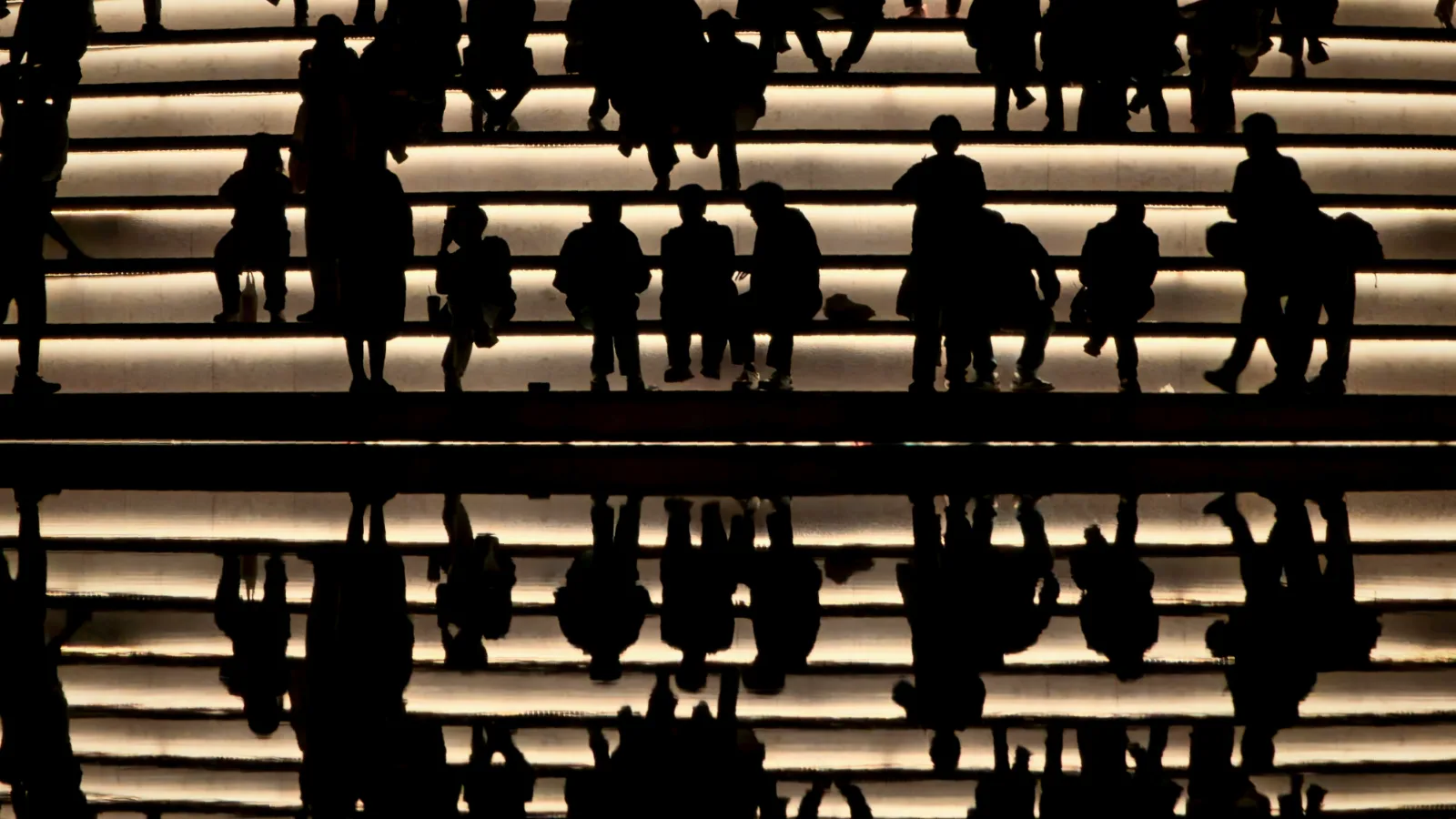
On power, judgement, and the mirror we hold up to one another.
Pick up a hand mirror. Hold it up to someone else’s face.
What does that person see? Themselves. Their eyes, their skin, perhaps a crumb on their chin.
And what do you see? Only the back of the mirror.

Put very simply, that is what happens when we judge someone. We hold up a mirror to another person. Look, this is how you do it. This is going well, this needs to improve. That is necessary. A child learns from it, a student, a colleague, an entire country. Without a mirror, nobody sees their own crumbs.
But whoever holds the mirror cannot see themselves. They see only the glass at the back. And the higher someone stands, the more often they hold the mirror, and the rarer it is that anyone holds one up to them.
Perhaps you have seen it happen. Someone delivers a sharp verdict on another person in a full room. Firmly, audibly, for everyone to hear. And you quietly wonder whether that judge would meet their own standard. Two questions come to mind. On what grounds? And right behind it: who actually holds the mirror up to you?
That is the question of this piece. Who judges the judge?
I can already tell you the answer I hope to leave you with at the end. Judging is necessary. But a judgement only becomes trustworthy when the judge can be judged too. Whoever holds up a mirror to someone else must also dare to look into one.
To understand why that is so hard, we need to go a long way back. To a time when the mirror still worked in both directions.
When the group still judged the leader
Picture a small group of people, tens of thousands of years ago. Thirty, perhaps forty of them. They hunt together, gather together, share the meat. There is no king, no boss, no director.

Did such a group have a leader at all? Yes, but not in the way we use the word today. The American anthropologist Christopher Boehm studied accounts of dozens of small, egalitarian societies, many of them hunter-gatherers. There, a leader was someone you listened to, not someone you had to obey. Someone with courage and experience. Someone who could calm a quarrel. Someone who could choose wisely where the group should move next.
According to Boehm, such a leader was expected to be generous, fair, impartial, tactful and a good speaker.1 He led by persuasion, not by command. In one of the societies Boehm describes, people simply stopped listening the moment a leader began to give orders.1
But influence can pull. Sometimes such a leader, or someone else with a great deal of sway, tried to become more than the first among equals. Then something remarkable happened. It was not the leader who kept the group in check. The group kept the leader in check.1
Boehm called this a reverse dominance hierarchy. In plain words: the ordinary members stood together above the one who wanted to be boss.
How did they do it? With tools we still recognise today. Anyone who grew too big for their boots was laughed at. People talked about him. They simply did not do what he said. If it got worse, the group moved on without him, or shut him out. In some of the societies studied, a man who kept trying to dominate was even killed.1
Harsh, and certainly no ideal. But the principle is clear. The mirror worked in both directions. Whoever judged others was constantly being watched as well. By everyone.
That changed when people began to farm and settle. According to Boehm, the reverse hierarchy was then turned back the other way.1 There were stores, property, inheritance. There were people who had more than others, and who wanted to keep it. Groups became too large for everyone to know everyone. You could no longer laugh at a powerful man without consequences. You could no longer simply walk away.
From that moment on, the mirror increasingly pointed in only one direction. From the top down.
And only then did the question of this piece become a real question. The Greek philosopher Plato wrote about it around 375 BC in his Republic. He described guardians who were to protect the city. One of the speakers says it would be ridiculous for a guardian to need a guardian himself.2 Plato’s answer was education. Choose the best people, shape them well, and supervision becomes unnecessary.

Some five centuries later, the Roman poet Juvenal took a far gloomier view. In a mocking poem, a man is advised to lock up his wife and put guards at the door. His reply is the line that became famous: Quis custodiet ipsos custodes? Who will guard the guards themselves?3 Guards are only human too, he meant. They can also be bribed, seduced, carried away.
Two old answers, then. Plato says: choose the right people and control is unnecessary. Juvenal says: control is pointless, because the controller is only human too.
Almost every organisation today quietly lives by Plato. We assume that whoever becomes a judge is also suited to the role. But what actually happens to a person once the mirror is placed in their hands?
What power does to the way you see
Try this. Use your finger to draw a capital E on your own forehead. Really do it; it takes two seconds.
How did you draw it? There are two ways.
In the first, you write the E as you would on paper. To you, it feels right. But anyone standing opposite sees it in mirror image. Back to front.
In the second, you write the E so that the other person can read it. That takes a moment’s thought. You have to put yourself in the place of someone looking at you.
In 2006 the American psychologist Adam Galinsky used exactly this test. He divided students into two groups. One group first wrote a short account of a time when they had power over someone else. The other group wrote about a time when someone else had power over them. Then everyone drew the E on their forehead.
The difference was striking. Among the students who had just been thinking about their own power, one in three drew the E from their own point of view, unreadable to anyone else. In the other group, it was about one in eight.4 In follow-up experiments, people in the power group were also worse at reading emotions on faces.
A few minutes of thinking about power was enough to make people less able to see what someone else sees.
That is the heart of it. Power does not necessarily make people bad. Above all, power makes them one-sided. Whoever stands above has less need to look closely at those below. Whoever stands below has to watch those above very closely indeed. Their safety depends on it.

One caveat: this was a small experiment, with 57 students. Read the result as a tendency, not a law of nature. Many people with power stay attentive. But the tendency is there.
More than a century earlier, a British historian had already sensed this. In 1887 Lord Acton wrote a letter to a bishop. The bishop believed historians should judge popes and kings rather more gently than ordinary people. Acton refused. If you must start with a presumption, he wrote, let it be against those who hold power. And then he wrote the line that would travel the world:
Power tends to corrupt and absolute power corrupts absolutely.
Lord Acton5
To corrupt here means to spoil slowly. Step by step, a person becomes less honest, more self-serving and less critical of themselves, often without noticing it.
Notice, too, the word tends. Acton did not say that power always spoils. He said it pulls in a certain direction. Like a mirror you hold the same way for so long that you forget it has another side.
So power narrows the way we look outwards. But it gets more uncomfortable still. Because how well does a person actually look inwards?
The man who thought lemon juice made him invisible
Pittsburgh, 1995. A man robs two banks. He wears no mask. The security cameras simply film his face.
He is recognised and arrested. When the police show him the footage, he is genuinely bewildered. But I wore the juice, he says.
He had rubbed lemon juice on his face. Lemon juice can be used as invisible ink. So he reasoned: then it will make my face invisible to the camera too.6
It sounds like a joke, but the story is true. The American psychologist David Dunning later told it to explain what his best-known research is about. How can someone be so certain of something so clearly wrong? And does the same thing happen to ordinary people, on a smaller scale?
In 1999 Dunning and his student Justin Kruger set up a series of experiments. Students took tests in logical reasoning, grammar and recognising humour. Afterwards they had to estimate how well they had done compared with everyone else.
Picture a hundred people standing in a long line. On the far left is whoever scored worst; on the far right, whoever scored best. The weakest group stood, on average, at place twelve. They believed they stood at place sixty-two. Above the middle, in other words.7
Why? Dunning and Kruger’s explanation is simple and slightly painful. To see that you have made a grammatical mistake, you need knowledge of grammar. Precisely the knowledge you lack. So whoever is not good at something often also lacks the tools to see that they are not good at it.
Yet this famous story has a second side. The research became so well known that people now use it as an insult. That is just Dunning-Kruger, we say about someone we dislike. But in 2020 two psychologists, Gilles Gignac and Marcin Zajenkowski, showed that part of that famous picture may be a statistical effect. Almost everyone rates themselves a little too highly. If you then sort people into groups, this pattern appears on its own. In their own data, they barely found the special effect at all.8
So what remains? The observation itself. The weakest group really did rate themselves far too highly. Only the explanation is still debated. For this story, that is enough. Whoever judges themselves is holding their own mirror. And a mirror you hold yourself can easily be tilted, just slightly, without your noticing.
That says something about the confident judge from the start of this piece. Perhaps he feels no unease because he does not see what you see. That is no excuse. It is precisely why nobody should rely on their own reflection alone.
And it does not only apply to him. It applies to you. And to me.
We now know two things. Power narrows how we see others. And how we see ourselves was never very sharp to begin with. More than five hundred years ago, someone wrote down how people in power deal with this in practice. His name became an insult.
Machiavelli: the man who described the back of the mirror
Florence, 1513. A civil servant without a job sits in prison. He is interrogated and tortured.
His name is Niccolò Machiavelli. For fourteen years he served the Florentine republic as a senior official and diplomat. He carried out diplomatic missions across Italy and Europe, and saw at close quarters how power really works. When the powerful Medici family returned in 1512, the republic was dissolved. Machiavelli lost his post. A few months later he was suspected of conspiracy and locked up.9

He was released, but his career was over. He withdrew to a family farm outside the city. There, in late 1513 or early 1514, he wrote the little book that would make him famous and notorious: The Prince.
What made that book so shocking? Machiavelli refused to pretend. He wrote:
How men live is so far removed from how they ought to live, that he who abandons what is done for what ought to be done, will rather learn to bring about his own ruin than his preservation.
Niccolò Machiavelli10
In plain words: Machiavelli did not describe how a leader ought to be. He described how leaders really are. The back of the mirror, you might say.
And what did he see there? He wrote that it is much safer for a prince to be feared than loved, if one of the two has to be wanting.10 And he wrote a sentence that goes straight to the heart of our subject:
Every one sees what you appear to be, few really know what you are, and those few dare not oppose themselves to the opinion of the many, who have the majesty of the state to defend them.
Niccolò Machiavelli10
Read that sentence again, slowly. It describes how a judge becomes untouchable. The outside world sees the confident performance. A few people close by see what is really going on. But they stay silent, because the group and the whole system stand behind the person in power.
Yet this is only half of Machiavelli. And the other half is often forgotten.
In his larger work, the Discourses on Roman history, he shows a very different face. There he turns out to favour the republic. He argued that Rome stayed free precisely because the people and the nobility kept clashing. From that discord, he wrote, came the laws that protected liberty.9
That is striking. The man who wrote the best-known handbook for rulers believed that freedom arises when power is contradicted. He showed the back of the mirror precisely so that you would know what to watch for.
Robert Greene and the party that was too beautiful
Almost five hundred years later, in 1998, a book appeared that brought Machiavelli’s way of seeing into our own time. The American writer Robert Greene gathered stories about power from three thousand years of history and distilled them into forty-eight laws. The 48 Laws of Power became a worldwide bestseller.11
His first law reads: Never outshine the master.
Greene illustrates that law with a true story. France, 1661. Nicolas Fouquet is finance minister to the young King Louis XIV, and one of the most powerful men in the country. He has had a magnificent château built: Vaux-le-Vicomte.

On 17 August 1661 Fouquet holds a celebration there in honour of the king. Thousands of guests. A tour of the gardens, a dinner, a new play by Molière, music, fireworks.12 Fouquet wants to show how devoted he is.
The king sees something else. He sees a servant who is richer, more refined and more impressive than he is himself.

Less than three weeks later, on 5 September, Fouquet is arrested in Nantes by d’Artagnan, captain of the king’s musketeers. After a trial lasting three years, the king changes his sentence to life imprisonment. Fouquet dies in 1680 in the fortress of Pignerol, never having been free again.12
Greene’s lesson: always make those above you feel comfortably superior.11
Machiavelli wrote for those at the top. Greene writes mostly for those below. Together they describe a system that keeps itself going. Those at the top learn that being feared is safer. Those below learn to keep themselves small. Do not seem too clever. Do not be too good. Do not let it show that you can do something better than the person judging you.
Think that through for a moment. In such a system, the most talented people learn that talent is dangerous. They learn to keep quiet, even when they see a mistake. And the judge never again hears anything unwelcome. Not because he is flawless, but because everyone has learned not to tell him.
Greene is not a scientist. His book contains no research, only history and interpretation. You can read it in two ways. As a handbook, it teaches you to survive in a bad system. As a mirror, it shows you why such a system is so hard to change.
Fouquet’s party is more than three hundred and fifty years old. But the question of whether you may be better than the person who judges you still plays out every day. At home, at school, at work, within countries and between them.
From the kitchen table to the map of the world
Now zoom out. At every level of life, the same question returns. And each time you see the same three ingredients.
- There is a difference in power. One person can give the other something, or take it away.
- The judge sets the standard.
- The route for objecting runs through that same judge, or does not exist.
Let us go through the levels one by one.
At home
It begins at the kitchen table. Parents judge their children every day, and rightly so. A child needs direction, boundaries, someone who says: not like that.
But look at the three ingredients. The difference in power is total. A child depends entirely on its parents for food, shelter and love. The parents set the standard. And objecting? A child cannot leave and cannot vote.
The Convention on the Rights of the Child tries to do something about this. It states that a child who is capable of forming their own views has the right to express them freely in all matters affecting them. And that those views must be given due weight, in keeping with the child’s age and maturity.13
That looks fine on paper. In the kitchen it is harder. A child’s verdict on its parents usually comes much later. Sometimes not until the child is an adult, or has children of their own. And sometimes, by then, the parent’s verdict has long since become a voice inside the child’s own head.
How many of the strict voices in your head were once someone else’s verdict?
At school
At school the mirror becomes more official. There are marks, reports, recommendations. And a new problem appears. What happens when it is not only the child, but the school itself that is judged by numbers?
In 1979 the American social scientist Donald Campbell wrote a warning that became known as Campbell’s law. The more a number is used to make important decisions, the more pressure people come under to make that number look good. And the more that number distorts the very process it was meant to measure.14
In plain words: when the mirror matters more than the face, people learn to pose for the mirror. A class then practises for the test instead of learning the subject.
At work
At work, everything we have seen so far comes together. This is where I want to stay longest, because this is where adults spend most of their waking hours.
Look first at the judge’s position. In many workplaces, one person is teacher, judge and gatekeeper all at once. He teaches you the job. He writes down how you are doing. And his verdict helps decide your contract, your training or your next step. That is a great deal of power in one pair of hands.
Then look at the quality of the judgement itself. In 2000 a team led by the American psychologist Steven Scullen studied the ratings of more than 4,400 managers, each of whom was rated by seven people. The question: what is a rating actually about?
The answer was sobering. More than half of the differences in the scores came from the personal style of the person doing the rating. How strict or lenient he was, and what he personally paid attention to. Only about a quarter reflected how well the person being rated actually performed.15
So a rating often says more about the mirror than about the face.
Next, look at how a verdict is delivered. In 1996 the psychologists Avraham Kluger and Angelo DeNisi brought together hundreds of measurements from decades of research on feedback. On average, feedback helped people forward. But in more than a third of cases, people actually performed worse afterwards.16 The difference lay mainly here. When the feedback was about the task, it often helped. When it was about the person, energy went into defence and shame rather than into the work.
This step went too fast is not the same as you cannot do this.
And then there is tone. In 2015, twenty-four teams from a neonatal intensive care unit practised an emergency involving a premature baby. A supposed foreign expert observed them. With half of the teams, he made a few mildly rude remarks that had nothing to do with their work. Those teams then made poorer diagnoses and carried out procedures less well. They shared less information and asked for help less often.17
Mild remarks, from an outsider, and still the quality dropped. Now imagine what a public reprimand does, from someone who decides your future.
Look, too, at the other people in the room. In 1968 the psychologists John Darley and Bibb Latané showed that people are slower to step in when more others are present. Everyone assumes someone else will do something. They called it diffusion of responsibility.18 A reprimand in a meeting is not an emergency. But the mechanism is recognisable. Ten silent colleagues are not ten choices. They are one shared silence. And that silence tells the judge: this is allowed.

That leaves three questions that are rarely asked out loud in many workplaces.
The first: who actually taught the judge how to judge? Someone can be excellent at their job and still never have learned how to observe, record and give feedback fairly.
The second: does a judge have to be better at the job? Not necessarily. A football coach does not need to run faster than his players. But he does need to know what good play looks like, and be able to explain what his judgement is based on.
The third: when did the judge last receive an honest verdict from someone below him? In many workplaces feedback flows like water: only downhill. And if objecting runs through the same line as the verdict itself, everyone knows how that ends. Greene’s first law does the rest.
Is there a standard for a fair assessment? In 1976 the American psychologist Gerald Leventhal described six conditions under which people experience a procedure as fair.19 Translated to the workplace, they sound like this:
- The same rules for everyone, including the judge.
- Whoever has a stake in the outcome does not decide alone.
- The verdict rests on good, complete information, not on an impression.
- There is a way back if the verdict turns out to be wrong.
- Whoever is being judged gets a voice.
- The whole thing fits ordinary human decency.
Hold a verdict that felt unfair up against this list. Often you will see exactly which condition was missing.
Country
The larger the scale, the larger the mirror. And the harder it becomes to see who is holding it.
In 1748 the French thinker Montesquieu wrote that it is an eternal experience that every person with power is tempted to abuse it. His solution became the foundation of the modern constitutional state: le pouvoir arrête le pouvoir. Power must check power.20 Those who make the laws, those who carry them out and those who judge them should not be the same people. They hold up a mirror to one another.
But at the level of a country, the mirror can disappear in two ways.
The first is familiar: a leader who has been in power so long and so high up that nobody contradicts him any more. The British doctor and former foreign secretary David Owen and the psychiatrist Jonathan Davidson proposed a name for it, hubris syndrome.21 It is not a recognised diagnosis, but anyone who follows the news will recognise the pattern without needing a name.
The second is quieter, and perhaps more dangerous. In 1970 the philosopher Hannah Arendt described bureaucracy as rule by Nobody.22 A system of rules, counters and procedures in which no single person feels responsible. And if nobody is responsible, there is also nobody you can hold to account.
Picture a citizen being judged by such a system. A form, a rule, a tick box. The verdict goes wrong. But who made the judgement? Nobody. The system. And so it can take years before anyone says: this was wrong. The judge is then no longer a person. It is a procedure. And a procedure never looks in the mirror.
Earth
At the highest level, the question becomes sharpest. Who judges the most powerful countries?
In the United Nations Security Council, five countries hold a permanent seat, and the heaviest decisions require the agreement of all five. Under the UN Charter, a country that is itself party to a dispute must abstain only when the peaceful settlement of that dispute is being decided, not when enforcement measures are.23 In plain words: in the heaviest decisions, the most powerful party can block a judgement about itself.
And then there are those being judged who have no voice yet. Children, and generations not yet born, will live with the consequences of today’s choices. They can only hold up the mirror to us when it is too late.

Finally, a new judge is arriving. We are teaching computers to judge people: who gets a loan, who is invited to an interview. And so the old question returns in a new form. Who holds up the mirror to the machine?
So the same question returns at every level. From the kitchen table to the map of the world. What, then, would actually help?
Where the mirror stops being true
Every comparison breaks somewhere. The mirror breaks in three places, and those three teach us the most.
First, a face stays the same however you hold the mirror. A person does not. A verdict seeps inwards. It can help someone grow, or teach them to make themselves smaller than they are.
Second, a reflection cannot answer back. A person can. The one being judged often knows something the judge did not see. That is why both sides should be heard. Not out of politeness, but because the judgement improves.
Third, and this is the hardest: even a smudged mirror sometimes shows exactly what is there. It is very human to think: whoever falls short themselves has no right to judge me. That feeling is understandable. And yet it is not quite right. In logic this error is called tu quoque, Latin for you too. You do it yourself says something about the speaker, but nothing about whether their point is correct. A judge with flaws can still be right.
So the right to judge does not depend on being flawless. It depends on something else: being willing to be judged yourself.
What does that look like? The American political scientist Elinor Ostrom received the Nobel Prize in Economics in 2009. She studied communities that sometimes managed fishing grounds, pastures and water sources together for centuries without things going wrong. One of her findings speaks directly to our subject. In the successful communities, those who did the monitoring were themselves accountable to the people they monitored. Or they belonged to that group themselves.24
If you think about it, that is the band of hunters from tens of thousands of years ago. It is Machiavelli’s Rome. It is Montesquieu’s power checking power. The same answer each time. Not one perfect guardian above all the guardians, because then Juvenal’s question goes on for ever. But a circle of mirrors, in which everyone both looks and is looked at.

And then the hardest part. Because we are all judges. As parents, colleagues, friends, voters. Even as readers of this piece, who may already have had someone in mind.
According to Plato, Socrates said at his trial that the greatest good for a person is to talk every day about what is good, examining both themselves and others. A life without that examination, he said, was not worth living.25 Notice the order. Oneself first.
Whoever dares to turn the mirror towards themselves loses no authority. They gain it. A judge who allows themselves to be judged does not become smaller. They become credible. People dare to tell them the truth again. And only then do they see what is really going on.
Who judges the judge? Not one person. Rather, a way of living together, at home, at school, at work, in a country and on this one earth. A way in which nobody stands so high that their own judgement stays out of view. Judging remains necessary. But whoever holds up a mirror to someone else must also dare to look into one.
And it starts small. With one judge who turns the mirror round, just for a moment.
Whose judgement weighs most heavily in your life, and when did you last ask someone to hold the mirror up to you?
This article provides general information and is not legal, medical or psychological advice. If you feel intimidated at work or in your training, talk to someone you trust, to a confidential adviser if your organisation has one, or to your GP if it is affecting your health.
Related reading
- Intelligence Is Not Enough. From Harvard to Hiroshima.
- You Are What You Repeatedly Do
- Why one child moves us, and a thousand leave us cold
Sources
The numbers in the text refer to this list.
- Boehm, C. (1993). Egalitarian behavior and reverse dominance hierarchy. Current Anthropology, 34(3), 227–254. https://doi.org/10.1086/204166
- Plato. (n.d.). The Republic, Book III (B. Jowett, Trans.). The Internet Classics Archive. https://classics.mit.edu/Plato/republic.4.iii.html (Original work written ca. 375 BC)
- Juvenal. (n.d.). Satires (Satire VI, lines 347–348). Perseus Digital Library. http://www.perseus.tufts.edu/hopper/text?doc=Perseus%3Atext%3A2007.01.0093%3Abook%3D2%3Apoem%3D6 (Original work written in the 2nd century AD)
- Galinsky, A. D., Magee, J. C., Inesi, M. E., & Gruenfeld, D. H. (2006). Power and perspectives not taken. Psychological Science, 17(12), 1068–1074. https://doi.org/10.1111/j.1467-9280.2006.01824.x
- Acton, J. E. E. D. (1887, April 5). Letter to Mandell Creighton. Hanover College History Department. https://history.hanover.edu/courses/excerpts/165acton.html
- Morris, E. (2010, June 20). The anosognosic’s dilemma: Something’s wrong but you’ll never know what it is (Part 1). The New York Times, Opinionator. https://archive.nytimes.com/opinionator.blogs.nytimes.com/2010/06/20/the-anosognosics-dilemma-1/
- Kruger, J., & Dunning, D. (1999). Unskilled and unaware of it: How difficulties in recognizing one’s own incompetence lead to inflated self-assessments. Journal of Personality and Social Psychology, 77(6), 1121–1134. https://doi.org/10.1037/0022-3514.77.6.1121
- Gignac, G. E., & Zajenkowski, M. (2020). The Dunning-Kruger effect is (mostly) a statistical artefact: Valid approaches to testing the hypothesis with individual differences data. Intelligence, 80, Article 101449. https://doi.org/10.1016/j.intell.2020.101449
- Nederman, C. (2023). Niccolò Machiavelli. In E. N. Zalta & U. Nodelman (Eds.), The Stanford encyclopedia of philosophy. https://plato.stanford.edu/entries/machiavelli/
- Machiavelli, N. (n.d.). The prince (W. K. Marriott, Trans.). Project Gutenberg. https://www.gutenberg.org/ebooks/1232 (Original work written in 1513–1514)
- Greene, R. (1998). The 48 laws of power. Viking.
- Webb, S. (n.d.). Nicolas Fouquet. In EBSCO Research Starters: History. EBSCO. https://www.ebsco.com/research-starters/history/nicolas-fouquet
- United Nations. (1989). Convention on the Rights of the Child. https://www.ohchr.org/en/instruments-mechanisms/instruments/convention-rights-child
- Campbell, D. T. (1979). Assessing the impact of planned social change. Evaluation and Program Planning, 2(1), 67–90. https://doi.org/10.1016/0149-7189(79)90048-X
- Scullen, S. E., Mount, M. K., & Goff, M. (2000). Understanding the latent structure of job performance ratings. Journal of Applied Psychology, 85(6), 956–970. https://doi.org/10.1037/0021-9010.85.6.956
- Kluger, A. N., & DeNisi, A. (1996). The effects of feedback interventions on performance: A historical review, a meta-analysis, and a preliminary feedback intervention theory. Psychological Bulletin, 119(2), 254–284. https://doi.org/10.1037/0033-2909.119.2.254
- Riskin, A., Erez, A., Foulk, T. A., Kugelman, A., Gover, A., Shoris, I., Riskin, K. S., & Bamberger, P. A. (2015). The impact of rudeness on medical team performance: A randomized trial. Pediatrics, 136(3), 487–495. https://doi.org/10.1542/peds.2015-1385
- Darley, J. M., & Latané, B. (1968). Bystander intervention in emergencies: Diffusion of responsibility. Journal of Personality and Social Psychology, 8(4), 377–383. https://doi.org/10.1037/h0025589
- Leventhal, G. S. (1976). What should be done with equity theory? New approaches to the study of fairness in social relationships (ED142463). ERIC. https://files.eric.ed.gov/fulltext/ED142463.pdf
- Montesquieu. (n.d.). De l’esprit des lois (Livre XI, chapitre 4). (Original work published in 1748)
- Owen, D., & Davidson, J. (2009). Hubris syndrome: An acquired personality disorder? A study of US Presidents and UK Prime Ministers over the last 100 years. Brain, 132(5), 1396–1406. https://doi.org/10.1093/brain/awp008
- Arendt, H. (1970). On violence. Harcourt, Brace & World.
- United Nations. (1945). Charter of the United Nations, Chapter V. https://www.un.org/en/about-us/un-charter/chapter-5
- Ostrom, E. (1990). Governing the commons: The evolution of institutions for collective action. Cambridge University Press. https://doi.org/10.1017/CBO9780511807763
- Plato. (n.d.). Apology (B. Jowett, Trans.). The Internet Classics Archive. https://classics.mit.edu/Plato/apology.html (Original work written after 399 BC)
Vaux-le-Vicomte image: photo Jean-Pol GRANDMONT, Wikimedia Commons, CC BY 4.0.
Sources on this site are cited in APA style, with a DOI wherever one exists. Why I made that choice →

About the author
Ilhama | withilhama.com · Medical specialist
I believe a person is made of many layers — shaped by what we live through, lose, learn and rebuild.
I write about what lives beneath the surface: memories, scent, silence, cooking, health and resilience.
On withilhama.com I connect science with humanity — honestly, warmly, and with care for the stories behind the facts.
My deepest conviction is that prevention is better than cure. That is why I translate complex knowledge into clear insights that help you live more consciously and make better choices.









.JPG)