
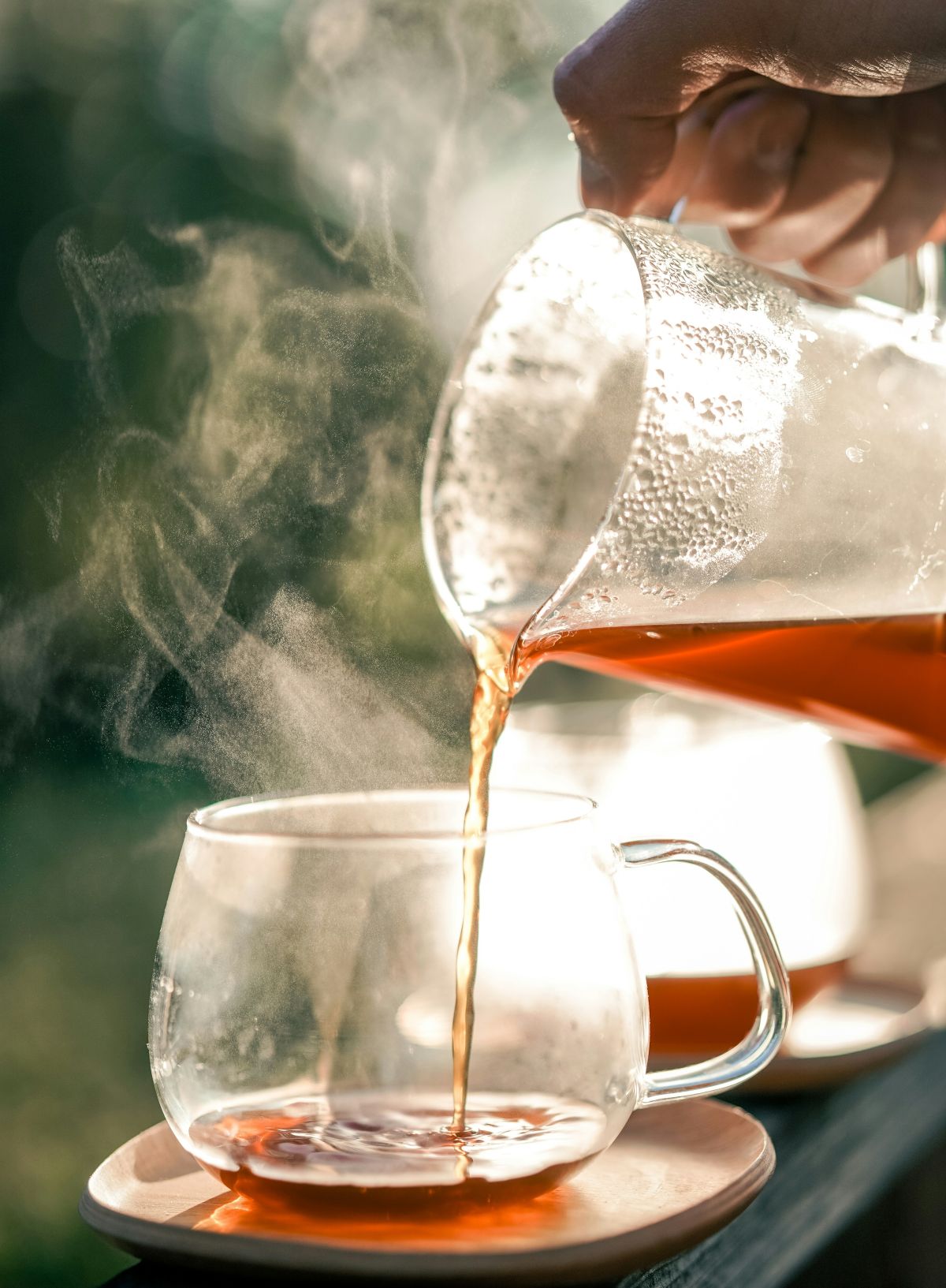
Perhaps you recognise this. You hang a teabag in your mug, pour boiling water over it, and watch the colour slowly change. One bag is translucent and silky — a “luxury” pyramid. Another is bright white. And sometimes it says unbleached, and the bag feels brownish and rough. For just a moment you think: unbleached… is that cheaper, then? Or actually better? And what am I drinking here, really?
I wondered about it too. We do this every day, sometimes several times. And precisely with something so ordinary, it pays to look calmly, just once, at what is really happening.
Because here is the heart of it: when you let a teabag steep, you are not only brewing the leaves. You are brewing the bag too. Hot water is a surprisingly powerful solvent — it draws substances out of almost anything you hang in it. So the question is not only which tea you drink, but also what you steep that tea in.
First: which bag are you holding?
The colour and the material tell you more than you think.
A translucent, silky pyramid bag looks chic, but is usually made of plastic — often nylon, PET or polypropylene. So precisely the “luxury” bags are often the plastic ones.
A bright white paper bag is bleached. That bright white does not come by itself; the paper has been lightened.
A brownish, unbleached bag is, by contrast, not bleached. And here I may correct your intuition for a moment: unbleached does not mean “cheap”. It usually means a bleaching step has been skipped — so less chemistry, not less quality. The cheap, generic bags are often the pure-white ones.
Three different bags, three different stories. Let’s look at them one by one.
The plastic bags: the story of the microplastics
In 2019 a study appeared that went viral. Researchers at McGill University steeped one plastic teabag in water at 95 °C, and reported that around 11.6 billion microplastics and 3.1 billion nanoplastics ended up from one bag in one cup of tea. That figure flew around the world.
And here comes the part you almost never hear online. That figure is probably substantially overestimated. The German Federal Institute for Risk Assessment (BfR) and a scientific comment repeated the measurement and arrived at something uncomfortable: because of the way the samples had been dried, dissolved substances were accidentally counted as if they were plastic particles. The actual number of real microplastics was probably two to three orders of magnitude lower — thousands instead of millions. Only a few per cent of the counted particles were actually plastic.
That does not make the problem go away. Plastic bags do release micro- and nanoplastics, certainly at high temperature. A more recent study from 2024 (Universitat Autònoma de Barcelona) examined bags of nylon-6, polypropylene and cellulose, and again saw that steeping releases enormous numbers of tiny particles. The new and exciting part: in a laboratory those particles were taken up by human intestinal cells — especially by the mucus-producing cells — and some even penetrated into the cell nucleus.
Does that sound alarming? I understand that. But here I must be honest, and that matters more than an exciting headline. These are cells in a dish, not people. That particles are taken up does not yet mean that they make us ill, or at what amount. The researchers say it themselves: we urgently need better, standardised methods, and we do not yet know what long-term exposure does to us. So the honest summary is: the exposure is real, the effect on health is still uncertain.

The paper bags: the story of bleaching and glue
Paper bags seem the safe choice. And often they are more so — paper does not release microplastics the way plastic does. But two less well-known things are at play.
The first is bleaching. White paper used to be bleached with chlorine, which can produce dioxins, substances that are harmful with long-term, high exposure. Modern factories mostly use chlorine-free methods (with oxygen or hydrogen peroxide), so those chlorine residues largely disappear. In properly produced paper the amounts are usually well below the harmful threshold. Unbleached paper simply sidesteps the question altogether.
The second is less well-known, and in my eyes more interesting: epichlorohydrin. This is a glue-like substance (a so-called wet-strength resin) added to a lot of teabag paper, so that the bag does not fall apart in hot water. Handy, but epichlorohydrin has been classified by the international cancer research agency IARC as “probably carcinogenic” (group 2A), and small amounts of it can end up in your tea with hot water. And this applies to bleached and unbleached paper, because it is in the strength of the paper, not in the colour.
Important to see this in proportion: it concerns traces, and with occasional use the risk is small. The question becomes more relevant if you, like many people, drink several cups every day, year in, year out. Not to be afraid of — but to be aware of.
Loose tea in a steel strainer, then?
This is, purely for the packaging question, the cleanest choice. A stainless-steel strainer or tea ball is inert: it gives nothing off to your tea, it contains no plastic, no bleach and no glue. You only steep the leaves — exactly what is intended.
But you probably saw it coming, and rightly: loose tea is not automatically “pure” either. The leaves themselves can contain residues of pesticides or heavy metals, depending on where and how the tea was grown. That has nothing to do with the bag and applies just as much to tea from a bag. So a steel strainer removes the packaging problems, but does not magically make the tea itself cleaner. The quality of the tea remains a separate story.

What I take from this
No panic, but a few calm insights.
The biggest avoidable combination is plastic plus heat. If there is one simple choice, it is this: better no translucent plastic pyramid bags with boiling water. A paper bag is, on that point, a step calmer, and loose tea in a steel strainer removes the packaging worries altogether.
And perhaps that is the loveliest lesson of this whole subject: a big, scary number in a cup is not the same as a big, scary risk for you. Science is still very much working this out here. Honestly saying what we do not know is not a weakness — it is exactly what you may expect from information you trust.
Do you have health complaints that you wonder might be linked to food or exposure? Discuss it with your GP or a specialist. This blog is here to help you understand, not to give medical advice.
I leave you with a gentle question. Which daily habit do you actually do on autopilot — and what would change if you looked at it calmly, just once?
Related reading
- What Is Money, Really?
- Shampoo from 79 Cents to 300 Euros — What Does Your Hair Really Absorb in Five Minutes?
Sources
- Hernandez LM, et al. Plastic Teabags Release Billions of Microparticles and Nanoparticles into Tea. Environmental Science & Technology. 2019;53(21):12300–12310. DOI: 10.1021/acs.est.9b02540. Accessed via PubMed.
- Busse K, et al. Comment on “Plastic Teabags Release Billions of Microparticles and Nanoparticles into Tea”. Environmental Science & Technology. 2020;54(21):14134–14135. DOI: 10.1021/acs.est.0c03182. Accessed via PubMed. (Reanalysis co-authored by the German BfR, judging the original counts substantially overestimated.)
- Banaei G, et al. Teabag-derived micro/nanoplastics (true-to-life MNPLs) as a surrogate for real-life exposure scenarios. Chemosphere. 2024;368:143736. DOI: 10.1016/j.chemosphere.2024.143736. Accessed via PubMed.
- Nour SMF, et al. Estimated daily intake of epichlorohydrin and certain heavy metals of bagged and loose black teas. Journal of Food Science and Technology. 2023;60(2):666–678. DOI: 10.1007/s13197-022-05652-5. Accessed via PubMed. (Epichlorohydrin as a wet-strength substance; classified by IARC as group 2A, “probably carcinogenic”.)
The health effects of micro- and nanoplastics in humans have not yet been established; many findings come from laboratory and cell research. The substances mentioned concern traces, where relevance applies mainly to long-term, daily exposure.
Leave a Reply