

It started with a golden chandelier on television. Explained without mathematics: what a bit is, what a qubit is, what the word quantum actually means, and where in the whole chain such a machine might one day do something useful.
Image above: Zoe-Rose Herbert / Department for Science, Innovation & Technology (DSIT), National Quantum Computing Centre, 25 October 2024, via Wikimedia Commons, CC BY 2.0. This version was cropped and converted to WebP.
Years ago I was sitting in front of the television and saw something I have never forgotten.
An enormous golden chandelier. Gleaming copper, layer upon layer, hundreds of little cables running downwards. It looked like a work of art. This, they said, is the quantum computer. Our future. What exactly I was looking at was never explained.
And in the same breath came the second part: that cyber criminals would be handed an enormous opportunity, and that soon everything could be hacked.
My own first thought was rather more practical. Beautiful object. Only, unless they make it a good deal more compact, it will never fit under my desk.

Photo: Dev Jadiya, IBM Quantum Computer Demo at ITU-WTSA 2024 in Delhi, 15 October 2024, via Wikimedia Commons, CC BY-SA 4.0. Converted to WebP; this version is shared under the same licence.
That image travelled the world in 2019. On 8 January, IBM presented the Q System One at CES, the large electronics fair in Las Vegas. The glass cube was almost three metres tall. The display case had been built by Goppion, which also made cases for the British crown jewels and the Mona Lisa. In October, Google made the news with a different quantum processor. It carried out a special computational task for which, by Google’s estimate at the time, a supercomputer would need around ten thousand years. Further on you will see why that comparison later changed.
Two things from that broadcast turned out to be half true.
Yes, that golden tower really is mostly a refrigerator.
No, it is not going to hack everything.
This article explains how it actually works. From the ground up, without mathematics. And it does not begin with the quantum computer, but with the computer in front of you right now.
You type: “The best places in Japan?” What happens then?
A little later an answer appears on your screen. Between your finger and that answer lie possibly thousands of kilometres and billions of tiny switches. We will follow the journey in seven steps.

1. You press a key.
Under every key sits a small switch. Your keyboard does not literally send the letter T. It sends a code saying which physical key you pressed. The software combines that code with your keyboard layout and turns it into a t or a T.
2. The letter becomes a number.
Computers use agreed tables in which every character is given a number. In the familiar ASCII and Unicode schemes, capital T is number 84, lower-case t is 116, lower-case e is 101, a space is 32 and a question mark is 63. Capitals and lower-case letters are therefore different characters, each with its own number.
This works like a cloakroom. You hand over your coat and receive ticket 84. The ticket is not your coat, but thanks to the agreement the attendant knows which coat belongs to it.
3. The number becomes bits.
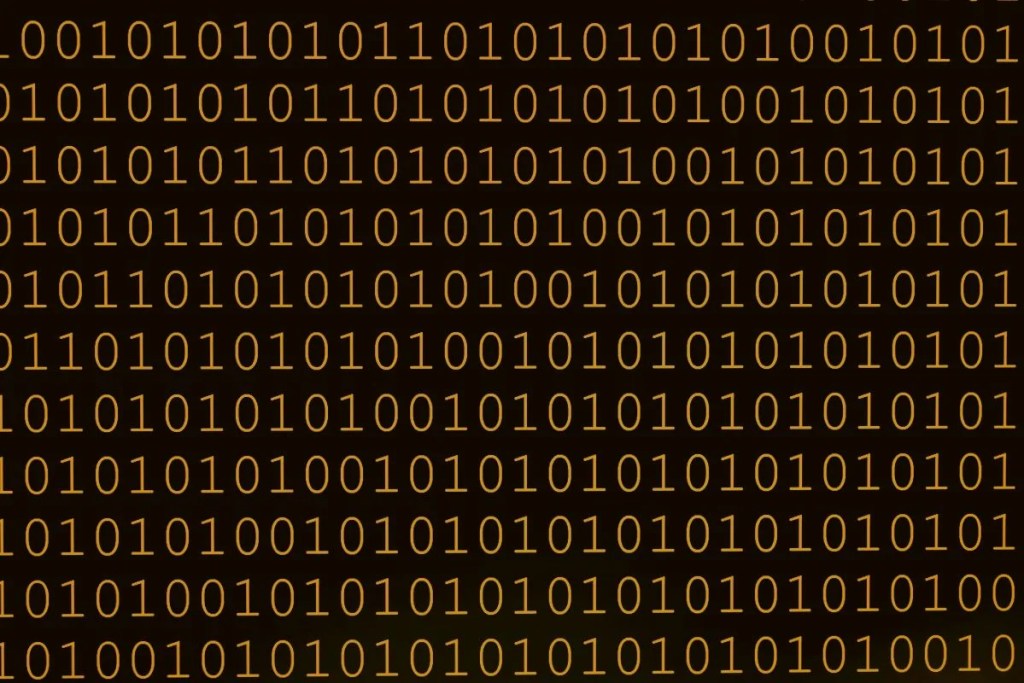
A bit can have two values: 0 or 1. Those zeros and ones do not float about inside your computer. They are our names for two clearly distinguishable physical states. In a chip that might, for example, be a low or a higher electrical voltage. In a fibre-optic cable, patterns of light pulses can carry the bits.
The start of your sentence looks like this:
t = 01110100h = 01101000e = 01100101space = 00100000
You read the. In this simplified example the computer processes 32 bits for it: four groups of eight.
4. The letters appear.
Your screen consists of millions of tiny lamps. Each picture element usually has three: red, green and blue. By making those three brighter or dimmer, every colour is produced.
That answers a question which often lingers: those points of light are precisely what you see. There is no letter inside your computer. There are lamps burning in a pattern that your eye recognises as a letter. Put your nose right up against the screen and you can see them individually.
5. You press Enter.
Only when you press Enter or the send button does the app send your question out. The connection is normally encrypted. The networking software divides the data into small, numbered packets and adds the digital destination address.
6. Your question travels.
Over wifi the bits are carried by radio signals. After that they may travel on as electrical signals through cables or as light pulses through fibre. Network devices along the way mainly look at where the packets need to go. At the server they are put back into the right order.
7. A server calculates, and the answer comes back.
Inside the secured computer system your sentence is divided into small pieces of text. An AI model then works out step by step which next piece of text most probably fits best. The answer is converted back into bits and sent across the network to your screen.
The whole journey:
your finger → key → number → bits → internet → server →calculation → bits → internet → letters → points of light on your screen
Almost everything a computer does consists of a long series of small conversions. Blindingly fast, but always according to learned or programmed rules. The hardware does not understand Japan the way you do. At the deepest level it changes the state of physical switches.
Why is it called a bit?
Bit is a shortening of binary digit. Binary means there are two possibilities; digit means numeral.
The mathematician John Tukey proposed the word bit. Claude Shannon used it in his celebrated 1948 publication and explicitly noted there that the word came from Tukey. That paper became a foundation of modern information theory. Shannon writes this himself in his original publication (Shannon, 1948).
That is how all the zeros and ones in the world began: with an abbreviation.

Visualisation: National Institute of Standards and Technology (NIST), “Qubits”, 6 July 2009, via Wikimedia Commons. Public domain in the United States; NIST requests appropriate image credit. Converted to WebP.
Only now that other word: quantum
Think of a slide and a staircase.
On a slide you can sit at any height. A centimetre higher, half a centimetre lower, everything in between is possible.
On a staircase you cannot. You stand on one step or the next. There is no half step.
In the very smallest world, nature sometimes behaves like that staircase. Some things do not change smoothly, but in fixed steps.
Physicists call one such individual permitted step a quantum.
A quantum is therefore not a mysterious little box or a separate object. The word packet is only an image. It means that, in that situation, a particular quantity cannot take every intermediate value.
So where is that quantum world?
Not on another planet. Not in a parallel universe. It is simply our own world, seen from very close up.
Your chair is made of molecules, molecules of atoms, and in and around those atoms sit smaller particles still. At that level, things behave differently from chairs and footballs.
A football lies in one place and rolls one way. A tiny particle can also behave like a wave. And a wave does not sit tidily in one place, it spreads out.
We find that strange. Nature does not. We find it strange because we are large and spend our whole lives looking at tables and bicycles.

How do we know that world really exists?
You cannot see the wind either. You see the leaves move.
It went the same way here. Around 1900, physicists ran into measurements that did not fit the old rules.
- Max Planck discovered that energy is not released smoothly, but in those steps. He received the Nobel Prize for it, with the citation naming his discovery of energy quanta.
- Albert Einstein used the idea of light quanta to explain the photoelectric effect: the phenomenon in which light can release electrons from a material. His 1921 Nobel Prize in Physics officially named above all his discovery of the law of this effect — not his theory of relativity (official Nobel Prize citation).
- Louis de Broglie proposed in 1924 something almost nobody believed at the time: that matter, too, can behave like a wave. Five years later he received the Nobel Prize, after experiments with electrons proved him right.
The decisive point is this: with those new rules, researchers could predict in advance what a new experiment would produce. And it was right. Time after time, up to the present day.
So we do not believe in the quantum world because somebody told a beautiful story. We know it because the predictions come true, and because without those rules you could not have built a transistor, a laser or an LED lamp. You use quantum physics all day without giving it a thought.
What is a qubit?
Qubit is a contraction of quantum bit. The word was written down in 1995 by the physicist Benjamin Schumacher.
When you read out a qubit, what you get in the end is simply a 0 or a 1.
Before that measurement, the qubit can be in a superposition: a controllable, wave-like combination in which both 0 and 1 play a part. That does not mean two complete answers are hidden inside it. You cannot simply open the two outcomes and read them both.
Superposition on its own does not yet deliver any miraculous computing power. The gain only arises when a suitable algorithm steers those quantum waves so that useless outcomes weaken one another and useful outcomes become more probable.
Why qubits can turn, and why that matters
The word turning is used in two ways where qubits are concerned.
Sometimes it refers to spin. That is a physical property of a particle, like mass and electrical charge. An electron is not literally a little top rotating on its axis. The name comes from the mathematics used to describe that property.
More often, researchers mean that the state of a qubit changes. They draw that state as a point on an imaginary sphere. The north pole stands for 0, the south pole for 1, and the other points stand for different superpositions.
A carefully tuned pulse moves that point. Such a change is called a quantum gate: one computational step of a quantum computer. A whole series of such changes makes up the calculation.
Measurement has nothing to do with looking
You often hear that a quantum particle “changes when you look at it”. All sorts of things are then imagined about consciousness and thoughts shaping reality.
That is not how it works.
By measurement, physicists mean a physical interaction between the qubit and a measuring instrument. The measurement yields an ordinary outcome: 0 or 1. The earlier superposition cannot then be read out again. A human being does not have to look at the result; consciousness plays no necessary part in this.

The trick: let the wrong answers cancel each other out
First, throw two pebbles into a pond.
Both make rings. Where those rings meet, something happens: two crests together make a higher wave, but a crest and a trough cancel each other out. There the water becomes almost flat.
Waves can therefore reinforce or cancel one another. Precisely this happens in the noise cancellation of a pair of headphones: the device produces a second sound wave that removes the noise.
And now the image this whole article turns on.
Picture a hall with a thousand voices. Each voice stands for a possible outcome.
For an unstructured search, an ordinary computer has to check the candidates one by one. A quantum algorithm works differently. It steers the wave patterns belonging to the possible outcomes.
Some wave patterns are steered so that they weaken one another. Others reinforce one another. The outcome you are looking for is usually not left as the only voice, but it can become far louder than the rest. That makes it more likely that this is the outcome you measure.
The calculation is therefore run several times. If the same outcome keeps coming back noticeably often, that pattern becomes visible.
And there sits the limitation too. The shouting is not the hard part. The choreography is. For most problems we know of no quantum recipe that makes the voices work together usefully.
So who gives the qubit that push?
Depending on the type of qubit, the machine uses microwaves, laser light or magnetic signals. The strength, duration and timing of every pulse have to be exactly right.
Many people assume the algorithm sets the qubit in motion. There is a step in between. Compare it to an orchestra:
- The algorithm is the sheet music.
- The ordinary computer beside it is the conductor.
- The pulses are the instructions.
- The qubits are the instruments.
Sheet music makes no sound of its own. There must always be something that converts the recipe into real, physical signals.
A qubit certainly can be flipped from 0 to 1. What is special is that pulses can also steer it into all kinds of superpositions. So you are not only controlling a final answer, but the entire quantum state. After that the calculation is often repeated many times, so that an ordinary computer can see which outcomes occur most frequently.

Photo: Ragsxl, working IQM quantum computer in Espoo, Finland, 21 August 2020, via Wikimedia Commons, CC BY-SA 4.0. This version was cropped, resized and converted to WebP and is shared under the same licence.
Back to that golden chandelier
Now it is possible to see what was standing on television that evening.
In this type of superconducting quantum computer, the golden structure is above all a cooling installation with a great deal of wiring. It keeps the small processor at the bottom extremely cold and delivers the control signals to the chip on which the qubits sit.
Around it stands considerably more: cabinets full of electronics, amplifiers, measuring equipment and ordinary computers that control the whole thing. Machines working with individual atoms or particles of light look entirely different, too. The golden tower is one design, not the quantum computer.
For ordinary users, a quantum computer will not become a device for under the desk. They will mostly use it via the cloud, as already happens today. Large companies and research institutions may well have their own installation on site. How many such systems will ultimately be needed depends on their cost, capacity and genuinely useful applications. IBM offers both cloud access and on-premises systems (IBM Quantum).
One stubborn misconception can be cleared up: a bigger refrigerator does not deliver a more powerful computer. More qubits also require more wiring, more control, more cooling capacity and considerably more error correction.
Where does such a machine fit into your question about Japan?
In this question, nowhere, and that says nothing about the quality of the machine. It says something about suitability.
A quantum computer does not itself understand English. Text can technically be encoded as quantum data, but that takes extra work and offers no known advantage for an ordinary language question. For What are the best places in Japan? an ordinary search engine or AI remains the appropriate tool.
Make the question heavier and the picture shifts, though only cautiously. Calculate the best route through a hundred Japanese towns, taking in travel times, prices, opening hours and the weather. That is not automatically a quantum job either, because ordinary computers already have clever methods for it. But suppose researchers one day find a single computational component for which a quantum recipe demonstrably works better. Then an ordinary server passes that one piece along.
The chain then becomes:
your question → ordinary computer → ordinary server →one special computational problem → qubits → measurements →ordinary bits → ordinary server → readable answer → your screen
What you hold in your hands remains ordinary technology from beginning to end: a keyboard, a network, a screen. Only somewhere deep in that chain is one computationally heavy component farmed out to a machine that works by different laws of nature, and from the outside you notice nothing of it. Just as, when watching a video, you do not see which part of your computer calculated each frame.
A quantum computer is not a master engine that speeds everything up. It is an auxiliary engine for one exceptionally heavy stretch of the journey.

So what does get faster, and can we reach a diagnosis sooner?
A computer is not “faster” in general. It can only be faster for a particular, precisely defined task.
The same applies here. Your email does not get faster. Your photographs do not get better. Netflix does not start any sooner.
And can we therefore reach a diagnosis sooner? The honest answer is: that has not yet been demonstrated.
A 2025 systematic review examined thousands of publications on quantum machine learning in digital health. Of the 169 eligible studies, 123 were excluded for insufficient methodological rigour, and only sixteen used realistic operating conditions: real quantum hardware or noisy simulations. The researchers found no consistent advantage over ordinary algorithms (Gupta et al., 2025).
So experiments and small demonstrations exist, but there is as yet no clinically proven chain in which a quantum computer demonstrably diagnoses patients faster or better. Current progress in recognising medical images and patient data comes above all from ordinary computers running AI. Quantum diagnostics is therefore, for the time being, a direction of research, not a proven clinical result.
Where it might genuinely matter for medicine lies one step earlier in the chain: at the molecule itself.
Molecules consist of particles that interact with one another according to quantum rules. To imitate such a molecule, an ordinary computer has to keep track of an enormous number of possible joint states.
Take a heavily simplified example in which each component has two possibilities. With ten components, 1,024 combinations arise. With thirty, there are already more than a billion. With a hundred you arrive at a number of 31 digits. Real molecular calculations are more complicated; not every added particle automatically doubles the work. The essential point still holds: the number of possibilities often grows extremely quickly, sometimes exponentially.
In such a simplified doubling model, a computer a thousand times faster gets you only about ten components further. That is not simply a speed problem. It is a wall that keeps rising faster.
Precisely this was seen by the physicist Richard Feynman as early as 1982. His reasoning was as simple as it was cheeky: if the small world plays by quantum rules, build your calculating machine out of the same stuff, and then nothing needs translating. Paul Benioff had already shown two years earlier that a computer can be described mathematically as a quantum system, and David Deutsch set out in 1985 what such a machine would look like in theory.
More than forty years have passed between Feynman’s proposal and today’s experimental machines. We now have working quantum processors, but not yet a broadly deployable, fault-tolerant quantum computer. That is not a failure. That is how slowly fundamental technology can grow.
Two famous algorithms show what is possible in theory. Peter Shor described a quantum algorithm that can efficiently factorise large numbers and also solve certain related mathematical problems. It therefore threatens RSA, Diffie–Hellman and elliptic-curve cryptography, among others. These are important components of internet security, but not all encryption.
Lov Grover showed that searching an unsorted collection of a million possibilities can take around a thousand checks, against an average of roughly half a million classical checks. In this simplified example that is hundreds of times fewer checks. It does not automatically mean the full calculation becomes equally faster on the wall clock.
So why do we still not have one?
Because qubits are easily disturbed. Depending on the technique used, heat, vibrations, electromagnetic noise, material defects or high-energy particles can cause errors before the calculation is finished.
That is why researchers build logical qubits: better-protected quantum information distributed across several physical qubits. Those physical qubits help detect and correct errors. Logical does not yet automatically mean error-free.
In December 2024, Google Quantum AI published an important step with the Willow processor. When the protective code was made larger, the error rate per correction cycle fell by slightly more than half. Making it bigger therefore genuinely helped.
The largest logical quantum memory in this experiment required 101 physical qubits. Even so, an average of roughly 0.143 per cent error per correction cycle remained — broadly one error every seven hundred cycles. This was an important milestone, but not yet a fully reliable qubit with which long practical calculations can be carried out (Nature study, including the correction incorporated in 2026).
The researchers write it themselves, in their own paper:
Orders of magnitude remain between present logical error rates and the requirements for practical quantum computation.
— Google Quantum AI and Collaborators, Nature (2025)
John Preskill gave this phase the name NISQ in 2018: Noisy Intermediate-Scale Quantum. By that he meant mid-sized quantum computers whose noise still limits how long they can calculate reliably. According to Preskill, such machines can be scientifically useful, but they do not change the world overnight (Preskill via Caltech).
Before you read the next headline
Back to that announcement from Google in October 2019. Their processor had performed a task in roughly 200 seconds which, by their estimate, would take the fastest ordinary supercomputer ten thousand years.
Three years later, Feng Pan, Keyang Chen and Pan Zhang (physicists at the Institute of Theoretical Physics of the Chinese Academy of Sciences in Beijing) developed a classical method for the sampling problem behind the Sycamore benchmark. Using a cluster of 512 graphics processors, they were able to generate outcomes at the intended fidelity in roughly fifteen hours (Physical Review Letters).
That did not make the original quantum calculation wrong. What changed was the classical comparison: researchers had meanwhile found a far cleverer way to imitate the benchmark.
So when you read somewhere that a quantum computer “did something that would take millions of years”, do not ask how fast it was. Ask: which task exactly, compared with what, and checked by whom?
And the fear from that television broadcast?
It was not plucked out of thin air, but neither was it as it sounded.
“Everything can be hacked” is not true. Shor’s algorithm mainly threatens public-key systems such as RSA, Diffie–Hellman and elliptic-curve cryptography. These are used, among other things, to exchange keys securely and to verify digital signatures.

The data itself is then usually protected with symmetric encryption, such as AES. Shor’s algorithm does not break AES. Grover’s algorithm can in theory speed up such key searches, but the practical advantage is far more limited. The security of your wifi and your hard drive therefore does not suddenly disappear altogether.
A quantum computer that can genuinely break today’s large cryptographic keys does not, as far as is publicly known, yet exist. Nobody can reliably predict whether the remaining distance amounts to years or decades (current NIST guidance).
But the concern is real enough that work on a solution is already under way worldwide, quietly and behind the scenes. What that means for your work, your data and your privacy, and why experts say something must be done about it now, is too large for this article. That will be a separate piece, somewhere in the future.
The strangest part comes now
Physicists can predict to many decimal places what a quantum system will do. They build machines with it. They correct errors in it.
But ask physicists what the mathematics of a measurement tells us precisely about reality, and you will get different interpretations. On the measurable predictions they agree. On the story behind those predictions, not always.
They can calculate with extreme precision what you will measure, without everyone giving the same answer to the question of what “really” happens behind the scenes.
And still it works.
That is no disgrace, and you do the same thing yourself. You do not know how your phone sends a photograph to the other side of the world in two seconds. You send it anyway.
From Socrates we have the line I know that I know nothing. He probably never put it that briefly; it is a later summary, and I wrote about that in You Are What You Repeatedly Do. But the attitude behind it still holds, and it is far simpler than the slogan:
Do not pretend to know what you do not know.
That is all there is to it. And it is exactly what the cleverest people in this field do when they write in their own paper that orders of magnitude remain.
If you did not take in everything on a first reading, that does not mean you have failed. The technology is difficult, even when the basics are explained simply. Understanding often begins not with certainty, but with one good question that stays with you.
A closing word. This article has been a long journey for me. From that golden chandelier on television to weeks of searching, reading, asking questions and starting over, until I understood enough to be able to explain it in my own words. This field moves quickly. I will keep following the news and update this article as soon as something material changes. If you find an error, or if something remains unclear, do let me know. Your questions make the next piece better.
Related reading
Sources
- Arute, F., Arya, K., Babbush, R., Bacon, D., Bardin, J. C., Barends, R., Biswas, R., Boixo, S., Brandao, F. G. S. L., Buell, D. A., Burkett, B., Chen, Y., Chen, Z., Chiaro, B., Collins, R., Courtney, W., Dunsworth, A., Farhi, E., Foxen, B., … Martinis, J. M. (2019). Quantum supremacy using a programmable superconducting processor. Nature, 574(7779), 505–510. https://doi.org/10.1038/s41586-019-1666-5
- Benioff, P. (1980). The computer as a physical system: A microscopic quantum mechanical Hamiltonian model of computers as represented by Turing machines. Journal of Statistical Physics, 22(5), 563–591. https://doi.org/10.1007/BF01011339
- Deutsch, D. (1985). Quantum theory, the Church–Turing principle and the universal quantum computer. Proceedings of the Royal Society A, 400(1818), 97–117. https://doi.org/10.1098/rspa.1985.0070
- Feynman, R. P. (1982). Simulating physics with computers. International Journal of Theoretical Physics, 21(6–7), 467–488. https://doi.org/10.1007/BF02650179
- Google Quantum AI and Collaborators. (2025). Quantum error correction below the surface code threshold. Nature, 638(8052), 920–926. https://doi.org/10.1038/s41586-024-08449-y
- Google Quantum AI and Collaborators. (2026). Author correction: Quantum error correction below the surface code threshold. Nature, 653, E5. https://doi.org/10.1038/s41586-026-10559-8
- Grover, L. K. (1996). A fast quantum mechanical algorithm for database search. In Proceedings of the Twenty-Eighth Annual ACM Symposium on Theory of Computing (pp. 212–219). Association for Computing Machinery. https://doi.org/10.1145/237814.237866
- Gupta, R. S., Wood, C. E., Engstrom, T., Pole, J. D., & Shrapnel, S. (2025). A systematic review of quantum machine learning for digital health. npj Digital Medicine, 8(1), Article 237. https://doi.org/10.1038/s41746-025-01597-z
- IBM. (n.d.). Quantum computing products and services. https://www.ibm.com/quantum/products
- Lardinois, F. (2019, January 8). IBM unveils its first commercial quantum computer. TechCrunch. https://techcrunch.com/2019/01/08/ibm-unveils-its-first-commercial-quantum-computer/
- National Institute of Standards and Technology. (2026, June 16). Post-quantum cryptography. https://csrc.nist.gov/Projects/post-quantum-cryptography/faqs
- Nobel Prize Outreach. (n.d.-a). The Nobel Prize in Physics 1918. https://www.nobelprize.org/prizes/physics/1918/summary/
- Nobel Prize Outreach. (n.d.-b). The Nobel Prize in Physics 1921. https://www.nobelprize.org/prizes/physics/1921/summary/
- Nobel Prize Outreach. (n.d.-c). The Nobel Prize in Physics 1929. https://www.nobelprize.org/prizes/physics/1929/summary/
- Pan, F., Chen, K., & Zhang, P. (2022). Solving the sampling problem of the Sycamore quantum circuits. Physical Review Letters, 129(9), Article 090502. https://doi.org/10.1103/PhysRevLett.129.090502
- Preskill, J. (2018). Quantum computing in the NISQ era and beyond. Quantum, 2, 79. https://doi.org/10.22331/q-2018-08-06-79
- Reiher, M., Wiebe, N., Svore, K. M., Wecker, D., & Troyer, M. (2017). Elucidating reaction mechanisms on quantum computers. Proceedings of the National Academy of Sciences, 114(29), 7555–7560. https://doi.org/10.1073/pnas.1619152114
- Schumacher, B. (1995). Quantum coding. Physical Review A, 51(4), 2738–2747. https://doi.org/10.1103/PhysRevA.51.2738
- Shannon, C. E. (1948). A mathematical theory of communication. The Bell System Technical Journal, 27(3), 379–423. https://doi.org/10.1002/j.1538-7305.1948.tb01338.x
- Shor, P. W. (1997). Polynomial-time algorithms for prime factorization and discrete logarithms on a quantum computer. SIAM Journal on Computing, 26(5), 1484–1509. https://doi.org/10.1137/S0097539795293172
Sources on this site are cited in APA style, with a DOI wherever one exists. Why I made that choice →

About the author
Ilhama | withilhama.com · Medical specialist
I believe a person is made of many layers — shaped by what we live through, lose, learn and rebuild.
I write about what lives beneath the surface: memories, scent, silence, cooking, health and resilience.
On withilhama.com I connect science with humanity — honestly, warmly, and with care for the stories behind the facts.
My deepest conviction is that prevention is better than cure. That is why I translate complex knowledge into clear insights that help you live more consciously and make better choices.







.jpg)
