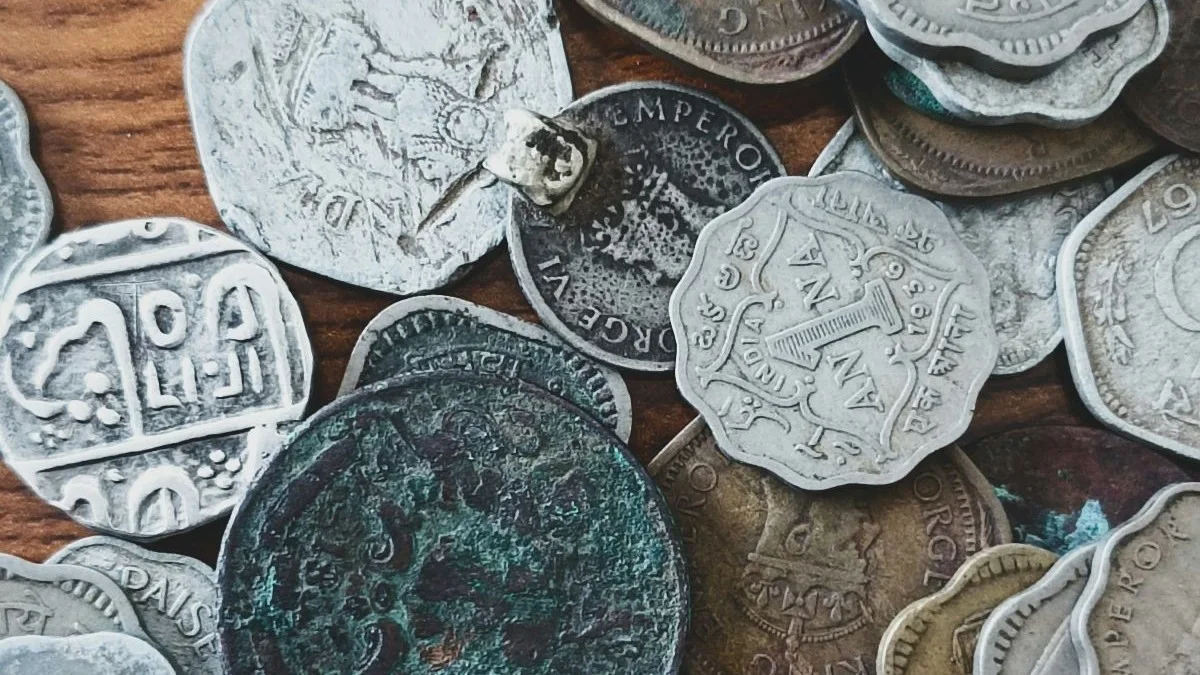
A story about 10,000 years of trust — from seashells to Bitcoin
I was in my early twenties, living in the country where I was born, studying medicine. I had been working and saving since the age of twelve, with one clear goal: one day I wanted to buy a home. Somewhere in the 1990s — a time when the whole region was shifting after the collapse of the Soviet Union — I stood there with my saved-up money in my hands. A lovely stack of crisp, new banknotes. Enough, I thought, for a flat, or at the very least for the deposit.
Then everything crashed. Within weeks, that same stack of money could buy me roughly a car. A few weeks later — and this is not an exaggeration — it bought two kilos of beef. Literally. Two kilos of beef for what was meant to become a house.
My father had seen it coming. He had quietly moved his wealth into something else: silk carpets. I didn’t understand why at the time. Only years later did I grasp what he knew and I didn’t. This is the story of what money actually is. What it has always been. What it has never been. And why my father could see that paper and value are not the same thing.

The great misconception about money
Most people think money has value because it is money. A fifty-euro note is worth fifty euros. Full stop. That isn’t quite right. Money has value because we agree with one another that it has value. Money is an agreement, not a thing. The note in your wallet is, in essence, a promise: that someone else will accept it from you in exchange for bread, petrol, an evening out.
As long as that promise holds, the money has value. When the promise breaks — as it did in my birth country in the 1990s — the note turns back into paper. Nothing more. That sounds philosophical, but it’s deeply practical: it explains why money has taken so many different shapes, and why now, in 2026, it is changing again.
Ten thousand years of money, at a glance
1. Barter
Long before money existed, people swapped directly. I have a goat, you have grain, we trade. This works, but it has one big problem economists call the double coincidence of wants: I want your grain, but you don’t want a goat — you want shoes. So first I have to find someone with shoes who wants my goat. By then, my goat has wandered off. Bartering works for two neighbours, not for a city.
One honest caveat, because this is the schoolbook version and it probably isn’t quite true. Anthropologists such as Caroline Humphrey and David Graeber point out that nowhere has anyone found evidence of a society that ran purely on barter and then “invented” money. What they did find: communities often kept track of debts and favours — who owed what to whom — long before there were any coins. Pure barter mostly happened between strangers, or precisely after a money system had collapsed, as I would later experience myself. “First barter, then money” is therefore a handy story for explaining money — not an established historical fact.
2. The first money — shells, salt, cattle, grain
The solution: pick one thing everyone wants, that doesn’t spoil, that you can count and that is hard to fake. In parts of Africa and Asia, that became cowrie shells. In the Roman Empire, salt played a role — our word salary traces back to the Latin salarium, which is linked to sal (salt), although linguists dispute whether soldiers were really paid in salt. The word pecunia (Latin for money) comes from pecus — cattle. And in ancient Mesopotamia, farmers brought their grain to temples, which gave them a clay tablet as proof — an early forerunner of paper money. What all these things had in common: within a community it was agreed that they held value, and as long as that agreement held, it worked.
3. Silver and gold — the universal money
Around 600 BC, in an area that is now Turkey (the kingdom of Lydia), people made coins for the first time from a blend of gold and silver, stamped with a mark — a lion — that said: this coin is genuine and worth this much. Gold and silver turned out to be ideal for millennia: they don’t spoil, they’re scarce, divisible, recognisable and desired almost everywhere. For nearly 2,500 years people across the world used gold and silver coins — the longest, most stable form of money humankind has ever known.

4. Paper — a proof of gold
Gold had one problem: it’s heavy. A merchant couldn’t lug a hundred kilos of gold around. The solution came from China (around the 7th century) and later Europe (around the 17th century): give me your gold, I’ll keep it in my vault, and I’ll give you a piece of paper with which you can reclaim it later — or with which you can pay someone else. And so paper money was born: in essence, a receipt for gold. The note itself had no value, but it represented gold in a vault. Everyone knew this, and that’s why it worked. Until one specific day in 1971.
1971: the day money changed meaning
On 15 August 1971, the American president Richard Nixon appeared on television with an announcement that would change the world. Until that moment, other countries could exchange their dollars with the U.S. government for gold, at a fixed price of 35 dollars per ounce. This system was called the Bretton Woods agreement and had existed since 1944. Nixon announced that it was being “temporarily” suspended. “Temporary” became permanent; the link was never restored, and within ten years every major currency followed.
From that moment on, we had what economists call fiat money. Fiat is Latin for “let it be done”. Money exists because a government says it exists. No gold behind it, no silver — only trust in the government that issues it. For the first time in 2,500 years, almost all the money on earth was no longer tied to anything physical.
What this meant for the world
When I stood in my kitchen with that stack of paper money that could buy only two kilos of beef, I was living through — in its most extreme form — what fiat money can do. When money is no longer bound to anything physical, governments can make as much of it as they like — no gold required, just a printing press, or today a computer adding zeroes to an account.
This isn’t a conspiracy theory; it’s how the system works. Central banks — such as the European Central Bank, the U.S. Federal Reserve or the Bank of Japan — can decide to bring more money into circulation. That’s called quantitative easing, or in plain language: printing money. The consequences:
- Inflation. More money in circulation without more goods means everything costs more. Your supermarket receipt is dearer than five years ago — not because the bread is better, but because more euros are fighting over the same loaf.
- Crises fought with more money. In 2008, central banks worldwide poured thousands of billions into the system. In 2020, during COVID, the same thing happened on an even larger scale — the Federal Reserve added trillions of dollars to its balance sheet. Money that didn’t exist, now existed.
- The inflation of 2021–2024. No coincidence, but a direct consequence. Prices shot up worldwide; groceries and energy grew dearer, and buying a home became almost out of reach for young people.
My father had seen this, in his own way, decades earlier. That’s why he bought not paper but silk carpets. He knew something I didn’t yet know: paper can be printed. A carpet cannot.
The digital money you already use
Something many people don’t realise: almost all the money you own today already exists not as notes or coins, but as numbers in a computer. When your salary lands, all that changes is a figure in a database. When you tap your card, no money moves — only a number travels from your account to the supermarket’s. For most people, the bulk of their money doesn’t sit in a wallet at all, but as a line in their bank’s ledger.
More remarkable still: banks can “create” digital money. When a bank gives you a 300,000-euro mortgage, that money doesn’t come from other customers’ savings — it comes into being the moment the loan is granted. This sounds improbable, but it is thoroughly documented, not least by the Bank of England, which in a now-famous 2014 report wrote that banks do indeed create money when they grant loans, not the other way around. Digital money, then, is nothing new; you’ve been using it for years. What is new are the alternative digital forms of money that try to work without banks or governments.

Bitcoin and Ethereum, a new attempt
In 2008, in the middle of the financial crisis, someone using the name Satoshi Nakamoto published a document on the internet. It described a new kind of money that is not made by a government, cannot be printed (there can only ever be a maximum of 21 million Bitcoins), works directly between people without a bank, and is protected by mathematics rather than by laws. Nobody knows who Satoshi Nakamoto is. But the idea — Bitcoin — came into the world and hasn’t left.
The technology behind it is called blockchain: every transaction is recorded in an enormous public ledger that sits on thousands of computers at once, constantly checking against one another, so that no one can forge it. In 2015 came Ethereum, which does something similar but with an addition: not just money, but contracts too can be settled via the blockchain. That made it the foundation for a larger ecosystem, including NFTs and so-called DeFi (decentralised finance).
In 2026, Bitcoin and Ethereum are increasingly being taken seriously by large financial institutions. In early 2025, the United States set up a strategic Bitcoin reserve by presidential order. And large, traditional banks are now stepping in themselves: in April 2026, Morgan Stanley became the first major American bank to launch a spot-bitcoin ETF under its own name, the Morgan Stanley Bitcoin Trust. The bitcoins themselves are held by Coinbase Custody and BNY; BNY also handles the administration and cash management. That a bank of this size would put its own name to bitcoin would have been unthinkable ten years ago.
Whether this is the start of something lasting or a passing fascination, nobody knows. In just over fifteen years, Bitcoin grew from an idea on a forum into a market worth hundreds of billions. But it is also volatile — the price can rise or fall 20 per cent in a week. For most people it is therefore not a replacement for a savings account, but something to look at with great caution.
The dollar in 2026 — stronger than often thought
Many articles predict “the fall of the dollar”. It’s worth looking at the facts:
- The dollar sits on one side of roughly 89 per cent of all global currency transactions — in 2022 it was 88 per cent.
- About 56 to 58 per cent of central banks’ reserves are held in dollars.
- International commodity trade — oil, grain, coffee — is still settled predominantly in dollars.
This gives America a unique position that economists call the exorbitant privilege: because everyone needs dollars, America can borrow, print and spend in ways that would be impossible for other countries.
BRICS — what it is and what it isn’t
On social media especially, an idea circulates that BRICS — originally Brazil, Russia, India, China and South Africa, expanded since 2024 with Egypt, Ethiopia, Iran and the UAE, among others (and Indonesia in early 2025) — is about to launch a joint currency that will replace the dollar. The facts are more nuanced: BRICS has announced no joint currency. India has repeatedly stressed it has no plan to replace the dollar, and Russia, too, says it does not want to abolish it. President Trump has, moreover, threatened steep import tariffs on BRICS countries that try to bypass the dollar.
What BRICS is doing: developing its own payment systems (BRICS Pay) so that countries can trade with one another without the dollar as an intermediary currency, and encouraging trade in local currencies. Russia and China are reported to now settle the great majority of their mutual trade in roubles and yuan. It isn’t a revolution, but a gradual shift: the dollar remains dominant, but less absolutely so than twenty years ago.
What this means for you — without financial advice
I am not a financial adviser. What follows is not advice, only insight:
- Money is an agreement, not a thing. What sits in your account has value as long as the agreement holds. That agreement has changed thousands of times in 2,500 years, and it will change again.
- Inflation is no accident. It is a built-in feature of fiat money. Not always bad — mild inflation can stimulate economies — but it does mean that money in a savings account can buy less over time.
- Diversification is thousands of years old. My father, with his silk carpets, did what sensible people have done since Mesopotamia: spread wealth across different forms. Not everything in one currency, not everything in one asset.
- Understanding protects. Those who never think about how money works are more vulnerable both to panic (everything into gold!) and to blindness (my pension will sort itself out). Those who understand the basics can watch calmly and make deliberate choices.
In closing
The girl in her early twenties who stood there with her stack of now-worthless paper learned something that month that wasn’t in any medical textbook: money is not paper. Money is trust. And trust can collapse. But that same afternoon she also learned something hopeful. Her father hadn’t seen this coming because he was a wizard, but because he had thought about what money actually is — and then acted on that understanding.
That is perhaps the single most important lesson from 10,000 years of monetary history. Not which currency wins, not whether Bitcoin is the future, not whether the dollar falls — but that people who think about what money really is can live more calmly in a world where it is forever changing. My father knew that decades ago, in a post-Soviet setting where almost no one had access to financial theory. Perhaps through experience, perhaps because his own father taught him. But he passed it on. And today I pass it on to you.
Related reading
- What’s Really in Your Teabag? On Plastic, Bleach and Hot Water
- Shampoo from 79 Cents to 300 Euros — What Does Your Hair Really Absorb in Five Minutes?
Sources
- Bank for International Settlements. (2025). OTC foreign exchange turnover in April 2025 (Triennial Central Bank Survey). https://www.bis.org/statistics/rpfx25_fx.htm
- British Museum. (n.d.). Coin [Electrum third-stater, Lydia, c. 575 BC; museum number 1866,1201.3669]. https://www.britishmuseum.org/collection/object/C_1866-1201-3669
- Buterin, V. (2014). Ethereum: A next-generation smart contract and decentralized application platform (Ethereum white paper). https://ethereum.org/en/whitepaper/
- Council on Foreign Relations. (n.d.). What is the BRICS group and why is it expanding? https://www.cfr.org/backgrounders/what-brics-group-and-why-it-expanding
- Davies, G. (2002). A history of money: From ancient times to the present day (3rd ed.). University of Wales Press.
- Eichengreen, B. (2011). Exorbitant privilege: The rise and fall of the dollar and the future of the international monetary system. Oxford University Press.
- European Central Bank. (n.d.-a). How quantitative easing works. https://www.ecb.europa.eu/ecb-and-you/explainers/show-me/html/app_infographic.en.html
- European Central Bank. (n.d.-b). What is money? https://www.ecb.europa.eu/ecb-and-you/explainers/tell-me-more/html/what_is_money.en.html
- Ghizoni, S. K. (2013a). Creation of the Bretton Woods system. Federal Reserve History. https://www.federalreservehistory.org/essays/bretton-woods-created
- Ghizoni, S. K. (2013b, November 22). Nixon ends convertibility of U.S. dollars to gold and announces wage/price controls. Federal Reserve History. https://www.federalreservehistory.org/essays/gold-convertibility-ends
- Graeber, D. (2011). Debt: The first 5,000 years. Melville House.
- Humphrey, C. (1985). Barter and economic disintegration. Man, 20(1), 48–72. https://doi.org/10.2307/2802221
- International Monetary Fund. (n.d.). Currency composition of official foreign exchange reserves (COFER) [Dataset]. https://data.imf.org/COFER
- Jevons, W. S. (1875). Money and the mechanism of exchange. H. S. King & Co.
- McLeay, M., Radia, A., & Thomas, R. (2014). Money creation in the modern economy. Bank of England Quarterly Bulletin, 2014 Q1, 14–27. https://www.bankofengland.co.uk/quarterly-bulletin/2014/q1/money-creation-in-the-modern-economy
- Morgan Stanley’s bitcoin ETF draws $33.9 million on day one. (2026, April 8). CoinDesk. https://www.coindesk.com/markets/2026/04/08/morgan-stanley-s-bitcoin-etf-draws-usd34-million-on-day-one
- Morgan Stanley taps Coinbase and BNY Mellon for custody in proposed bitcoin ETF. (2026, March 4). CoinDesk. https://www.coindesk.com/markets/2026/03/04/morgan-stanley-taps-coinbase-and-bny-mellon-for-custody-in-proposed-bitcoin-etf
- Nakamoto, S. (2008). Bitcoin: A peer-to-peer electronic cash system. https://bitcoin.org/bitcoin.pdf
- The White House. (2025, March 6). Establishment of the Strategic Bitcoin Reserve and United States Digital Asset Stockpile (Executive Order No. 14233). https://www.federalregister.gov/documents/2025/03/11/2025-03992/establishment-of-the-strategic-bitcoin-reserve-and-united-states-digital-asset-stockpile
Sources on this site are cited in APA style, with a DOI wherever one exists. Why I made that choice →

About the author
Ilhama | withilhama.com · Medical specialist
I believe a person is made of many layers — shaped by what we live through, lose, learn and rebuild.
I write about what lives beneath the surface: memories, scent, silence, cooking, health and resilience.
On withilhama.com I connect science with humanity — honestly, warmly, and with care for the stories behind the facts.
My deepest conviction is that prevention is better than cure. That is why I translate complex knowledge into clear insights that help you live more consciously and make better choices.