
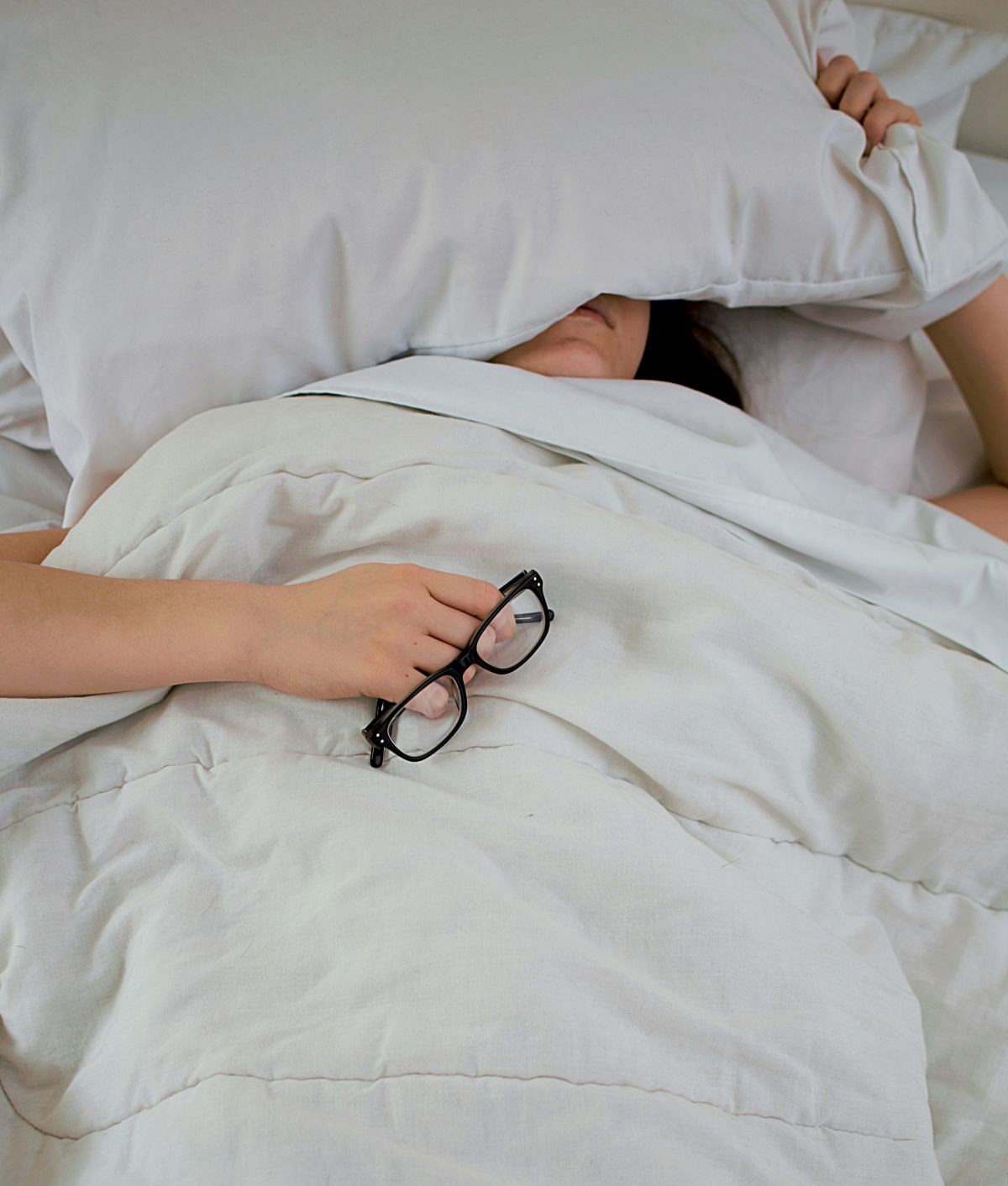
The surprising science behind the “sleep hangover”
You’d been looking forward to it. A morning with no alarm at last. No obligations, no rush. You slept in until late in the morning, and you woke up with… a headache.
It makes no sense. You did exactly what your body supposedly needed — more rest, more sleep — and yet you feel worse than after an ordinary seven-hour night. A dull, heavy headache, sometimes throbbing, sometimes like a band tightening around your head.
If this sounds familiar, you’re not alone. The phenomenon is so well known that it has nicknames: the “sleep hangover” or the “weekend headache”. And the surprising part is that there is real, fascinating science behind it. Though I want to be honest straight away — the exact why of a sleeping-in headache hasn’t been fully worked out. What follows are the best-supported explanations and a few strong hypotheses, not one proven truth. And it is precisely that honest, unfinished picture that teaches us something deeper about how our bodies work.
Let’s find out what is going on.
Not one cause, but several at once
The first thing worth understanding: there is probably no single culprit. A sleeping-in headache most likely arises from several mechanisms acting at the same time. That is why such a headache often feels confusing — part tension headache, part something throbbing. It is not one thing going wrong, but a few things together. Let’s look at them one by one — with the honest caveat that the first two are more hypothesis, and the later ones (caffeine, dehydration, posture) are more firmly established.

1. The chemical that guards your rhythm (hypothesis)
A frequently named lead character is a messenger chemical in your brain that you may have heard of: serotonin. It is involved in all sorts of things — your mood, your appetite — but also in regulating your sleep–wake rhythm. And it plays a role in migraine, where changes in serotonin and in the blood vessels can together produce pain.
Picture serotonin as an alarm clock that does not ring, but whispers. At a certain point in the morning it gives your brain the signal: it is time to wake up.
The hypothesis goes like this: when you ignore that wake-up signal and simply sleep on, you go against your own rhythm, and the fine-tuning of the serotonin system is thrown off. Because serotonin also influences how your blood vessels narrow and widen, the vessels in your head might then react differently — which can produce a throbbing, migraine-like pain.
Important: this is a plausible explanation, not a proven mechanism. But it does fit something we do see more often: people who are prone to migraine more frequently suffer sleeping-in headaches. Their system seems more sensitive to disruptions of rhythm.
2. Your body thinks it is already awake
This follows logically from the first idea, and it is surprisingly simple.
During a normal night you go for hours without drinking or eating, and that is fine — your body is set up for it. But when you sleep much longer than usual, you stretch that window without water and food even further. And mild dehydration is one of the best-known, best-supported causes of headache there is.
On top of that, once the “wake up” moment has passed, your body has effectively already expected to become active — and therefore to receive water and food to get everything going. If it does not, because you are staying comfortably in bed, a mild shortfall can build up that only lifts once you finally eat and drink something.
Your body is ready for the day. You are not. You feel that difference in your head.
3. The coffee that comes too late
This mechanism is often forgotten, but it is well described scientifically.
If you are used to drinking coffee at roughly a fixed time each morning, your body gets used to it — genuinely, physically used to it. So when you sleep in, that first coffee arrives hours later than normal. And caffeine withdrawal is a recognised phenomenon that can bring on a headache within twelve to twenty-four hours of your usual intake.
Your body simply misses its expected dose at the expected moment. It is not that coffee is so healthy — it is that your body adapts to a pattern, and a sudden deviation feels like a deficit. Once again you see the same theme: it is the disruption of rhythm that causes the pain, not the sleep itself.
4. Too long in the same position
This is the most physical explanation. When you lie much longer than usual in the same position, your neck and shoulder muscles can tense up. That produces a classic tension headache — that feeling of a tight band around your head, or pressure behind your eyes.
An awkward sleeping position, or a pillow that does not support your neck well, makes this worse the longer you stay put. On a normal night you turn over regularly; during a long, deep lie-in you sometimes stay too long in the same, not always ideal, position.
5. The grinding you know nothing about
Some people unconsciously clench or grind their teeth at night. This is called bruxism, and you usually notice nothing of it — except the consequences. It strains your jaw joint and jaw muscles, and in the morning you feel that as a headache around your temples and jaw.
Bruxism has been linked in research to morning headache, and it often goes together with stress, or sometimes with problems in breathing during sleep. Someone who ends the day tense sometimes carries that tension literally into the night, clenched in the jaw.
When it might be more than sleeping in
Here I want to be honest and careful. Most sleeping-in headaches are harmless and fit the mechanisms above. But there is an important distinction.
Do you have a headache now and then after a lazy lie-in? Then it is most likely the combination of dehydration, late caffeine and a disrupted rhythm. Nothing to worry about.
But if you wake up with a headache almost every morning — not only after sleeping in — then something else may be at play that deserves attention. One well-known cause is sleep apnoea: a condition in which breathing repeatedly pauses briefly during the night. Morning headache is a classic feature of it, often together with snoring, a dry mouth on waking, and daytime tiredness. This can be properly investigated and treated — but only if you have it looked at.
Go to your GP if morning headaches keep returning, or if a headache comes with signs such as confusion, vision problems or weakness. This article describes the science behind an ordinary, everyday phenomenon — it is not medical advice and is no substitute for a doctor.

The common thread: your body loves rhythm
What fascinates me most about this everyday discomfort is what lies beneath it. Look again at the mechanisms: the serotonin rhythm thrown off, the coffee that comes too late, the hydration drifting out of balance. They all lead back to one truth that does stand firm:
Your body loves regularity. And sleeping in, however lovely it feels, is a disruption of that rhythm.
There is a lovely paradox in that. We think more sleep is always better, that we can “catch up” on a shortfall with a long morning in bed. But your body is not a bank account where you can save up hours and withdraw them later. It is a rhythmic system that works best with consistency — waking around the same time every day, weekends included.
The sleeping-in headache is really a kind teacher. It reminds you that rest is not the same as standing still, and that your body thrives on rhythm, not on extremes — not too little, but not too much either.
So the next time you wake at the weekend with a heavy head, you will know: it is not a punishment and it is not chance. It is your body missing its rhythm. A glass of water, something to eat, a cup of coffee and a little daylight, and you help it back on track.
In closing
We live in a culture that sometimes treats sleep as something you can store up and pay back. But perhaps the deeper lesson is that your body is not asking for more, but for regularity. Not the largest amount, but the most reliable rhythm.
What does your rhythm look like at the weekend — do you sleep in much longer than on weekdays? And if you think about it: does your body truly feel better for it, or is it quietly asking for more regularity?
No quick answer. Just a question to carry with you, the next time the weekend begins.
Related reading
Sources
- Juliano, L. M., & Griffiths, R. R. (2004). A critical review of caffeine withdrawal: empirical validation of symptoms and signs, incidence, severity, and associated features. Psychopharmacology, 176(1), 1–29. DOI: 10.1007/s00213-004-2000-x (caffeine-withdrawal headache; onset within 12–24 hours)
- Headache Classification Committee of the International Headache Society (IHS). The International Classification of Headache Disorders, 3rd edition (ICHD-3). Cephalalgia, 2018;38(1):1–211. DOI: 10.1177/0333102417738202 (recognises both sleep apnoea headache and caffeine-withdrawal headache)
- The role of serotonin and the blood vessels in sleeping-in / weekend headache is a plausible hypothesis derived from migraine research, not a proven mechanism. Dehydration, caffeine withdrawal, muscle tension and bruxism are better-supported contributing factors.
Leave a Reply